
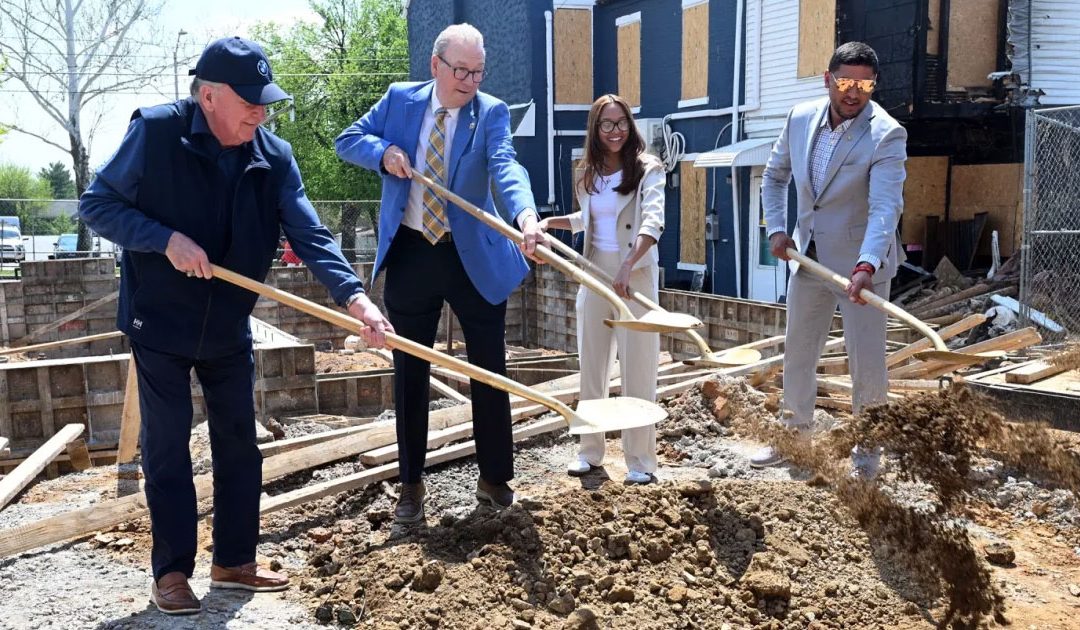
Groundbreaking highlights employer-supported homeownership initiative amid rising housing costs and ongoing shortage in Reading.
Representatives of Habitat for Humanity of Berks County and Olivet Boys and Girls Club joined Thursday to mark the start of construction on a home that will be owned by an Olivet employee.
The ceremonial groundbreaking at the rear of a vacant lot at 225 W. Buttonwood St. celebrates more than the start of a new home, said Timothy J. Daley, executive director of the nonprofit that helps provide affordable homes for the local workforce population.
It highlights a model of employer-supported housing that could be replicated across the region, he said.
“This is an extraordinary event,” Daley said. “It’s a tremendous example of how an employer and an employee can work together for the mutual benefit of both.”
The new home’s future owner, Pamela Perez, was recommended to Habitat’s First-Time Homebuyer Program by her employer, Olivet, he noted.
Daley described the project as a model solution to mounting workforce housing challenges and the difficulty of recruiting and retaining workers amid rising housing costs.
“Habitat’s role here is to be the resource,” he said. “The real winner here is the employer and the employee relationship.”
Rick Perez, CEO of Olivet, echoed that sentiment, emphasizing the organization’s investment not only in youth but in its staff.
“We take a lot of pride in our staff,” Perez said. “It is very important that we give our people the platform that once they elevate themselves that they are able to sustain that.”
Federal support is also helping fuel Habitat’s broader work, said Sabrina McLaughlin Walensky, regional representative for U.S. Sen. John Fetterman.
Fetterman’s office in February announced nearly $300 million in funding to support 121 projects in Pennsylvania, including $1.6 million to Habitat Berks to help revitalize the Ninth and Douglass streets neighborhood by acquisition of property, construction of new affordable housing and other efforts to eliminate blight.
The neighborhood in the vicinity of the new Reading High School Innovation Academy is one of three areas targeted by Habitat. The others are around the Buttonwood Street gateway and Goggleworks Center for the Arts.
Walensky described the appropriation as part of an effort to direct federal dollars toward projects, such as Habitat’s, that aim to strengthen communities through homeownership opportunities.
“He (Fetterman) was very happy to make an investment here in the city of Reading to help you in your work,” Walensky said.
For Richard Ehst, Habitat Berks board president, the nonprofit’s mission is practical and deeply personal.
A retired banker who has been involved with Habitat Berks for more than a dozen years, Ehst said providing affordable housing to working families is among the most meaningful forms of community service.
“There is nothing greater, I think, in this life, than to provide affordable housing to folks who are in the workplace already,” he said.
Ehst pointed to the broader impact such efforts can have in a city like Reading, where there are hundreds of blighted properties that could be rehabilitated to meet the housing shortage.
According to the city’s 2024-28 Equity Plan, Reading faces a severe housing shortage driven by a supply-demand gap, with rents rising over 60% in recent years and a need for 410 new units within five years to meet demand.
Reading’s 2019 Housing and Blight strategy identified nearly 300 blighted properties with another 300 to 500 at risk or in serious need of repair.
Ehst said Habitat hopes to partner with the city in a program that would expand the nonprofit’s access to such houses for rehabilitation or replacement with infill housing and future sale to working residents.
“We need to put efforts like that on steroids,” he said.
The Buttonwood project is a tangible example of what can happen when nonprofits, employers and government align, Daley said, and turn an empty lot into a foundation for stability, and potentially, a model for future housing solutions in Reading and Berks County.
Recent Comments